Wednesday, January 30, 2013

Grupo Godot - Sónar

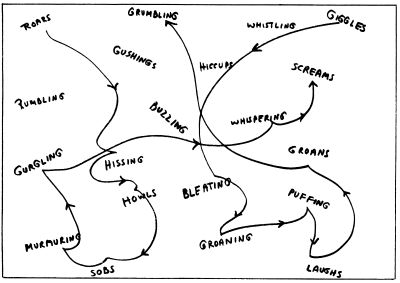
Sónar es acrónimo de Sound Navigation And Ranging, delimitando las conexiones entre descripción, imagen,  acción, movimiento y sonido, en un criterio de conexión entre grafismo y sonido que aparece en el fondo de la partitura gráfica PANZEE.


Grupo: Godot
Componentes: Miguel Copón, Ana Zugasti, Sofía Ramos
Organología: Guitarra y cello preparados. Voz. Electrónica


Una partitura gráfica es la delimitación de  las conexiones ambiguas entre elementos imaginarios y su transcripción mediante movimientos e interacciones con objetos en vibraciones controladas. En la intepretación de la propuesta PANZEE nuestro trabajo se divide en dos partes, como en una doble representación. 


Interpretación de la partitura según los parámetros de altura en la lectura de su escritura tradicional., utilizando los criterios gráficos provenientes del campo semántico de la palabra gráfico.

 
Godot: Panzee Score Ana Zugasti


Gráfico Graphic, griego grafikós(γραφικός) conserva una noción básica en el completo campo semántico de escritura: arañar, cortar, incidir, nombrando al proceso mediante el cual el cuerpo deposita una señal sobre un soporte para contruir una forma permanente, algo que se soporte frente al tiempo, y soporte, en una reinterpretación codificada, al tiempo mismo en forma de signos. El trabajo de interpretación, sea sonora, musical, hermenéutica o en teoría del conocimiento, propone la transformación constante de contenidos entre series de signos constituidos como campos. La interpretación siempre es una traducción, un modo de transición entre dos territorios de signos afines. Nuestra pieza es una reinterpretación, un bucle lanzado sobre el terreno intermedio de las interpretaciones: parte de una primera definición de los signos contenidos en la partitura desde su más evidente lectura, la lectura tradicional, sobre la que ya aparece con cierto grado de deformidad. La primera decisión sobre la partitura en su forma clásica será la organológica , se ha determinado que la transposición ha de ser análoga a la fuente, poiéticamente relacionada, por lo que se utilizará tanto en instrumentos como en ejecución fórmulas que tengan conexión con las rasgaduras, incisiones y arañazos, aplicadas a la guitarra preparada y al violoncello, donde el concepto se encuentra presente en primera línea. Los resultados sonoros de la interpretación medida de los datos de la partitura, delimitados en altura, duración, tiempo, rubato, sean recogidos en una primera grabación, una nueva partitura que se imprimirá gráficamente utilizando distintos software de visualización del sonido, desde los aplican cents  a los que leen espectralmente las distintas intensidades presentes.


Godot: Panzee Score. Ana Zugasti


 Click here to see an english translation of this page.


Saturday, January 26, 2013

Andrew Liles - Great Apeth

Artist: Andrew Liles
Project Title: Great Apeth

"Almost a literal translation of the the score....well my literal translation."

note:
Andrew's final contribution to the Panzee Project is an audio track accompanied by this image.


Friday, January 25, 2013

Craig Dongoski - Inter-Species Duration Structure

Artist: Craig Dongoski
Project Title: Inter-Species Duration Structure 


My specific outcome within this proposal is to produce a body of works on paper based on characters derived from the Panzee Score. Further, I will produce a sound piece based on the sounds of Panzee’s  mark-making mixed with other ambient sounds within her environment. I also plan to extend my results into a live sound-based performance using my visual results as an extended score.


I have been exploring and articulating the mark in its most basic form as a vehicle for communicative expression for much of my career. Working with chimpanzees (particularly Panzee) has opened a wide field of new possibilities to expand the scope of research. Panzee has produced marks for years; she spontaneously developed her own mark-making habit early in her life, but it has not been considered in any serious capacity. No one has analyzed or studied these in any way before. The significance of the marks to Panzee is as yet unknown; it is possible that the mark-making could be used in studies of recall memory. There is an overall shape, aesthetic deliberateness or intention; there is the evident visual concentration, there is the shape; the marks are evenly spaced and are carefully placed along very tightly spaced lines. Panzee's marks are seated in the solid artistic realms of ancient writing, calligraphy and gestural abstraction. We also know that art demonstrates its most radical shifts when there is a rupture in mark-making e.g. Van Gogh, Picasso, Pollock, Michaux, Rainer. Panzee provokes the potential of innate expression within human artistic practice and presents provocative statements both philosophically and artistically within this context. The intention is that through varied interpretations of the marks that a contribution is made to the art historical dialogue within the origin of human expression. 

Brian Reffin Smith

Artist: Brian Reffin Smith
Project Title: TBD

Relevant work can be found on zombiepataphysics.blogspot.de
Details about Brian Reffin Smith: http://en.wikipedia.org/wiki/Brian_Reffin_Smith 

Iʼve taken the score, digitally removed the stave lines
and enhanced the marks. I donʼt think the ape will mind.

Then this image is considered as a matrix of on or off cells in a cellular automaton ʻLifeʼ program, and ʻsnapshotsʼ are taken every few generations as a rule is iteratively applied to the image." These images are then inverted and transformed into sound on a simple X/Y basis, where X= time and Y= frequency. Each image (the result of the cellular operations) thus gives a piece of music.


These individual portions are then subject to some standard operations such as layering, concatenation, repetition and so on.

 
The result will be a series of images and an audio file. 

Arturo Moya Villén

Artist: Arturo Moya Villén.
Project Title: TBD

My project stems from a critical revision of Enlightenment as a way of
dominating and submitting nature, and proposes a space in which the body remains as
an nonconformist and irreductible being. The piece I propose for the
PANZEE PROJECT involves both concepts. It takes the form of a film of
a performance which tries to turn around that yearning for domination
and reflects on these processes involved. For once it will be man,
his body, who will submit to nature, the human being which will be
dominated, which will meekly follow an animal, a complete turnaround.
 

The performance will register my movements upon a piece of paper,
trying to exactly reproduce Panzee's movements whilst creating her
score. My movements, recorded by an infrared camera, will be used to
activate sound processes which will be mixed with sounds from the
lexigrams used by Panzee to communicate with humans, with others
linked to the idea of domination. Both Panzee's score and the
lexigrams with which she has learned to communicate, are proof that in
the mere possibility of this project's existence there is an
underlying and firmly rooted Enlightenment idea. The established game
is therefore not innocent, but recursive; a man submitting to an
animal, submitting in turn to man. Who am I submitting to then? And,
if my movements activate the sounds which Panzee uses to communicate,
what are my movements turning into? Moreover, who is talking? And,
what is he saying?

Bio
Arturo Moya Villén. Composer, sound artist, performer and
electroacoustic and experimental music curator. His works (for
traditional instruments, electroacoustic or mixed) installations,
appearances, videos and performances have been exhibited in Spain,
Italy, Chile, Argentina, Cuba, United States, Mexico, France, Belgium,
United Kingdom and Germany. He has been president of the AMEE (Spanish
Electroacoustic Music Asociation) and Director at the “Festival
Internacional de Música Electroacústica, Punto de Encuentro”. He is
currently director of the Ensemble S'il Beuys Plight, produces sound
installations with Miguel Copon under the name COMO?, presents
multichannel concerts, is curator of experimental music, sound art and
multichannel concerts  at CircuitoElectrovisiones  and is founder
member of EX, an association dedicated to electronic and experimental
art.

Thursday, January 24, 2013

Images and sound.
Norman McLaren: Pen Point Percussion


Wednesday, January 23, 2013

John Roach - Words in Zoo

Artist: John  Roach 
Proposal Title: Words in Zoo


My immediate response to Panzee's score was to imagine it governing a set of spatial instructions. the score has the feeling of paths and other directional cues interspersed with topographical smudges and small notations indicating areas of interest.


My strategy is to overlay the score on a map of the Bronx Zoo, one of the few locations humans in New York City have to be in the presence of our primate relatives.

Because Panzee is a chimp with special language abilities, I will focus some of my attention of language
The marks in the score will be used to determine the location of a series of field recordings at the zoo. Because the zoo is heavily populated by Homo Sapiens I will focus on capturing conversations. Marks on the score will be used to determine the location of the recordings (a long line, like the one that runs through the center, will indicate a lengthy recording covering a large distance)


The score will then be used to do the following:
  • dictate edits to the recorded material
  • cue a number of invited performers who will utilize the specific areas within the score 
  • determine filtering and manipulation to the recorded material


Sample:In this audio fragment I have used a strip of the
Panzee score to manipulate the sound of my kids' laughter.


Tuesday, January 22, 2013

Wilfrido Terrazas - Proposal


Artist: Wilfrido Terrazas
Project Title:
TBD
      
My idea for the Panzee Project 2013 is fairly simple: I intend to record an interpretation of Panzee’s score. For this, I’ll play the flute(s) to the score, and record myself while doing it. At first glance, the score struck me as being very attractive and compelling; mysterious, even. I could imagine myself improvising inspired by it. It has very defined shapes, which I can relate to, sonically, mainly for two reasons: First, because of my long experience as a performer of graphic scores; Secondly, and much more important, because of my personal experience as a composer, particularly in the last few years. In the early stages of many of my compositions, I use graphs as a compositional tool. They help me to organize both sound materials and temporality. I am used to transporting graphic information into sound. After I define certain things through these graphs, I go on to work with musical notation. I find this opportunity extremely interesting, then. Panzee’s score has very unique characteristics, as would be expected. I will try to imagine a unique sound world for it, as best I can.


WILFRIDO TERRAZAS (Camargo, 1974) is a Mexican flutist and composer. He collaborates with composers frequently and has premiered over 200 works to the date. He is a member of the Mexican improvisation project Generación Espontánea and teaches flute at the Conservatorio de las Rosas in Morelia. He has recorded three solo albums: Open Cages (Umor, 2007), Bóreas (Shival, 2010) and Bug/ge/d (Mandorla, 2010). He lives in Mexico City, where he is active in both the written and improvised experimental music scenes.


Monday, January 14, 2013

CRAY - Mar Zee Pan


Artist: Cray
Project title: Mar Zee Pan 


The idea behind this work, and all my current works, is to enjoy the surprise, communication and beauty in pure electronic- self playing patches.
When I first looked at Panzee’s score it made me think of the patch cables of my Buchla modular synthesizer so I started to make a patch based on the image from Panzee. 

Where we see Panzee communicating to us via his score he is also communicating to us at a deeper level just like how the electronics also communicate to us at a deeper level than just audio wave vibrations. 


Video Still from Mar Zee Pan Video
Profile:
CRAY is Australian composer Ross Healy. Ross has been heavily involved with electronic music since the early 90's releasing recordings for labels in Australia, Germany, France, United Kingdom, Ireland and the U.S under many different names (This Digital Ocean, Amnesia, Siko Spunji, Roland Oberheim, Ryou Oonishi, 56k, Oskar T Oram and Cray) covering many styles of electronic music, Avant improv electronics, Experimental computer music, Noise, Industrial, Techno, Ambient, IDM and Drum n Bass. As well as his lust for electronic music making , Ross has also co-run Global Warming Club, Melbourne), written for Digital magazine, remixed (demixed) artists work, designed web page sounds, had his music used in TV shows and commercials and has performed live around the globe. Ross is also the founding member of VICMOD, where they teach people how to build (solder electronic) modular synthesizers.
Ross is also the co-founder of VICMOD Records, which specializes in experimental avant electronics.
www.vicmod.net

Thursday, November 8, 2012

the sad part


Fig. 1. The Chinpanzee in quiet
Fig. 2. The Chimpanzee depressed
 Fig. 3—4. The Chimpanzee sad (groaning)
Fig. 5—6. The Chimpanzee crying

the funny part


Fig. 1—2. The Chimpanzee in high spirits
Fig. 3—4. The narrow grin of the Chimpanzee
Fig. 5—6. The broad grin of the Chimpanzee
Fig. 7. The boisterous laugh of the Chimpanzee
Fig. 8. The Chimpanzee's laughter

drinking problem

Fig. 1. Drinking from cup (final stage)
Fig. 2. Drinking from cup (initial stage)
Fig. 3. Drinking from saucer with help of man
Fig. 4. Drinking from saucer unhelped
Fig. 5—6. Drinking from saucer animal-like

Tuesday, October 16, 2012

Stephen Vitiello


Study for Graphic Score 2007

Walter Marchetti

Fly Movements on a window glass 
from 8 in the morning to 7 in the evening one day of May 1967

Morton Feldman


'De Kooning' by Morton Feldman c.1963

R. Murray Schafer


'When Words Sing', from The Thinking Ear,
(Indian River, Ontario: Arcana Editions, 1986) p. 197.

Primate Glossary


aggression - used for expressing displeasure, demonstrating that another male can't protect a female, social control (mobbing), males managing relations among females 
communication - 4 parts: signal, motivation, meaning, function - what's the unit size of a signal - meaning is context-based - proximate function is immediate, ultimate function is long-term
communication, basic - what you can't lie about - sex, age, species, sexual receptivity (estrus swelling), sickness, fear scent in gorillas
communication channel - actual nervous input that comes into brain - eg. sense of smell, touch, heating
communication, interactive - individual has some choice with this - eg. do I make a scent mark, threat
communication modality - what you do with a particular channel - olfactory channel: scent marking, pheromone production - visual channel: facial gestures, hand and body gestures, piloerection, kinesis, proxemics- auditory channel: clear calls, harsh calls
communication, nonverbal - sounds, but not words
communication, nonvocal - everything but sounds - subtle, fast, accurate
inspection - sniffing the genital region - very common, especially of infants
instinctive behaviour - behaviour without observation, eg. clinging, sucking, rooting ritualized (occurs same way each time), comes from a particular stimulus (eg. hunger)
interaction, conflict - neither participant gets what they want -eg. males fighting over a female, another male takes it away
interaction, conflict assymetric - one animal gives in because of harassment - eg. male harasses a female until she lets him mount
interaction, mutual - actions of animals are cooperative - eg. grooming
interaction, reactive - one animal attempts to interact, other ignores - eg. male lets female eat nearby
intermembral index - ratio of length of arms to legs - higher ratio means arms that much longer than legs
proxemics - an animal's use of space
territoriality - defending area against others of same species
tool use - modify shape of what you' re using to fulfill a function better - eg. chimpanzees using sticks to get termites and ants

Complete Primate Glossary Link


History of Ape Language

History of Ape Language, Kanzi

The field of primatology is relatively new to the academic world, officially recognized in 1966 with the meeting of the First Congress of The International Society for Primatology. Because it encompasses disciplines and methodologies from anthropology, biology, medicine, psychology and sociology, primatology occupies a central place in today’s intellectual studies of human origins and behavior. As it expands to include studies of higher cognitive processes such as language and consciousness, primatology will also begin to encompass physics, art and music.
The research underway at Great Ape Trust continues the traditional form of primatology and expands it to new horizons. The field began with a very limited view of the capabilities of non-human primates and an interest in defining innate behaviors as opposed to learned behaviors. Until now, the view was that man alone possessed true abilities for rational thought, culture, morality and language. Decades of work have shaken the initial assumptions to the core and have begun to redefine what it is to be a primate and consequently what it is to be human.
New technologies for studying the minds of other primates are emerging and developing in the highly supportive and collaborative research environment offered at Great Ape Trust. The techniques that are being brought on line for future long-term studies of culture, language, intelligence and tools are innovative. They are a synthetic product of: the keyboard Yerkish Language approach developed by Dr. Duane Rumbaugh in the early 1970’s; the intra-species language paradigms developed by Dr. Sue Savage-Rumbaugh in the late 1970’s; the NASA Space Flight Battery of Primate Intelligence developed by the Rumbaughs and Dr. David Washburn in the 1980’s; the Forest Environment for Spontaneous Language Acquisition developed by the Rumbaughs in the 1980’s; and the maturation of all these technologies into long-term kinship-based studies of the Origins and Future of Language, Culture, Tools and Intelligence, at Great Ape Trust.
The environment for non-human primates that is emerging at Great Ape Trust is unique in the world. Few other research communities have access to the kinds of indoor and outdoor facilities for great apes that are being developed at The Trust.
These facilities provide the basis for far more detailed and complex investigations than have ever been conceived, except in nature. This environment provides the infrastructure for completely new means of investigating our own origins.
The blossoming of Great Ape Trust comes at a time when it is becoming clear that genetics must be paired with environment if we are to understand change across time.

Sunday, October 14, 2012

InterSpecies Collaboration: Panzee & Craig Dongoski

Cabinet Issue Cover

Susan Savage-Rumbaugh: The gentle genius of bonobos


http://www.ted.com Savage-Rumbaugh's work with bonobo apes, which can understand spoken language and learn tasks by watching, forces the audience to rethink how much of what a species can do is determined by biology -- and how much by cultural exposure.


Teaching Language to an Ape - Columbia University


Sarah, a young chimpanzee, has a reading and writing vocabulary of about 130 "words".

http://www.columbia.edu/cu/psychology/terrace/w1001/readings/premack.pdf


Sarah (chimpanzee)


Sarah is an enculturated research chimpanzee whose cognitive skills are documented in The Mind of an Ape, by David Premack and Ann James Premack (1983).[1] Sarah was one of nine chimpanzees in David Premack's psychology laboratory in Pennsylvania. Sarah was born in Africa in 1962. She first worked in Missouri, then in Santa Barbara, and then Pennsylvania. She first was exposed to language token training in 1967.
Sarah was the subject, along with 3 other chimpanzees who were exposed to language token training. One of the chimpanzees failed to learn a single word. But Sarah, Elizabeth and Peony were able to parse and also produce streams of tokens which obeyed a grammar.
She used a special board with plastic symbols to correctly parse various syntactic expressions including if-then-else.
When the Premacks decided they no longer wanted to work with chimpanzees in 1987, Sarah was sent to Sarah Boysen's Chimp Center at the Ohio State University, where she lived and worked with other enculturated chimpanzees: Kermit, Darrell, Bobby, Sheba, Keeli, Ivy, Harper and Emma. In February 2006, the Chimp Center was closed and OSU sent the chimps to a private animal collection in Texas, and subsequently transferred to another chimpanzee sanctuary, Chimp Haven, in Louisiana.


Friday, October 12, 2012

Teaching the Ape to Write Poems

 
by James Tate

They didn't have much trouble
teaching the ape to write poems:
first they strapped him into the chair,
then tied the pencil around his hand
(the paper had already been nailed down).
Then Dr. Bluespire leaned over his shoulder
and whispered into his ear:
"You look like a god sitting there.
Why don't you try writing something?"
 

James Tate
About his work, the poet John Ashbery wrote in the New York Times: "Local color plays a role, but the main event is the poet's wrestling with passing moments, frantically trying to discover the poetry there and to preserve it, perishable as it is. Tate is the poet of possibilities, of morph, of surprising consequences, lovely or disastrous, and these phenomena exist everywhere... I return to Tate's books more often perhaps than to any others when I want to be reminded afresh of the possibilities of poetry."
Tate's honors include a National Institute of Arts and Letters Award for Poetry, the Wallace Stevens Award, a 1995 Tanning Prize, and fellowships from the Guggenheim Foundation and the National Endowment for the Arts. In 2001, he was elected a Chancellor of the Academy of American Poets.
He teaches at the University of Massachusetts in Amherst.
 

Panzee


Panzee, a female chimpanzee, was born in 1985. Panzee was raised with a bonobo (Pan paniscus) in a comparative study of language acquisition. Unlike with Lana and Sherman, Panzee was never intentionally taught to use lexigrams. Instead, she was reared in an environment much like that of human children. She learned to use lexigrams from watching other humans use the symbols around her in communicatively valid contexts. Panzee also spontaneously demonstrated comprehension of spoken English, and her comprehension has remained high across the years. In addition to language acquisition research, Panzee has served in experiments examining memory, object permanence, planning, delay of gratification, and brain imaging of language comprehension.

Wednesday, October 10, 2012

The Ape and the Sushi Master by Frans de Waal


Two monkeys smoking pipe
Etching by Coryn Boel (1620–1668), after David Teniers


What if apes had their own culture rather than one their human observers imposed on them? What if they reacted to situations with behavior learned through observation of their elders (culture) rather than with pure genetically coded instinct (nature)? Contemplating such a possibility is bound to shake centuries-old cultural convictions. In answering these questions, The Ape and the Sushi Master, by the eminent primatologist Frans de Waal, corrects our arrogant assumption that humans are the only form of intelligent life to have made the leap from the natural to the cultural domain. The book's title derives from an analogy de Waal draws between the way behavior is transmitted in ape society and the way sushi-making skills are passed down from sushi master to apprentice. Like the apprentice, young apes watch their group mates at close range, absorbing the methods and lessons of each of their elders' actions. Responses long thought to be instinctive are actually learned behavior, de Waal argues, and constitute ape culture. A delightful, partly autobiographical mix of anecdotes, rigorous research, and fascinating speculation, The Ape and the Sushi Master challenges our most basic assumptions about who we are and how we differ from other animals. Apes are holding a new mirror up to us in which they are not human caricatures but members of our extended family with their own resourcefulness and dignity. For over a century, UFO spotters have told us that we are not alone. In The Ape and the Sushi Master, Frans de Waal makes the equally startling claim that, biologically speaking, we never were.

Scientists Rethinking Nature of Animal Memory


National Geographic News: NATIONALGEOGRAPHIC.COM/NEWS

Bijal P. Trivedi
National Geographic Today
August 22, 2003
An elephant never forgets—or does it?

Scientists have long believed that animals do not have so-called episodic memory—the kind that allows humans to remember past events. But recent experiments with scrub jays, chimpanzees, and gorillas have led to rethinking of the nature of memory in animals.

Animal memory researchers first face the challenge of communicating between species. "You can't exactly ask the animals where they were, and what they were doing, when Bambi's mother was shot," says Nicola Clayton, a professor of comparative cognition at University of Cambridge in England and a leading researcher in the field of animal memory.

Over the past six years Clayton has devised a series of ingenious experiments that seem to show that scrub jays can recall past events and use the information to plan for the future.


"We have traditionally regarded animals like machines, or automata, believing that they just have reflexes and habits," says John Pearce, a professor of psychology at Cardiff University in Wales. "Clayton's work is revolutionary because it challenges these ideas and suggests that animals have richer memories than previously thought."

Clayton chose scrub jays because she was fascinated by their food-caching behavior: They stash food to recover later. The jays adapt their caching habits to the perishability of the item, Clayton discovered. In one experiment, Clayton left out worms and peanuts for the jays to store. The birds preferred to retrieve the worms, unless a long period of time had elapsed. Then the birds went for the peanuts—a preference they presumably "remembered" from finding spoiled worms.

Mental Time Travel

One of Clayton's later experiments with the resourceful jays involved observing how they behaved when stashing food in caches that might be robbed by other birds. Jays with experience of such avian robbery were much more cautious about their stashes.

"It is as if the pilferer recognizes that its food could be stolen in the future and makes sure no one sees his cache," Clayton says. "This is the first time we have seen evidence that an animal other than a human recalled the social context of an event and adjusted its future behavior."

Psychologists say that episodic memory mediates the ability to remember—or to engage in a form of "mental time travel." The question is whether that ability is uniquely human.

"There are many beautiful examples of complex behavior that occur without higher thought or consciousness," cautions Endel Tulving, a cognitive psychologist at the Rotman Research Institute of Baycrest Center for Geriatric Care in Toronto. In his book "Elements of Episodic Memory," Tulving wrote that animals can adjust, adapt, and learn, but they cannot "travel back into the past in their own minds." But he enjoys the fact that scientists are challenging his ideas.

Neither Clayton nor Pearce are completely convinced yet that the jays have episodic memory and can replay past events in their minds like humans do. But the jay experiments have inspired similar studies in other species.

Bennett Schwartz, a cognitive psychologist at Florida International University in Miami, is studying memory in a western lowland gorilla named King.

Memory in Chimps and Gorillas

King, a 450-pound (205-kilogram) male silverback in his 30s, communicates with caretakers via picture cards. Using the cards, he has shown that he can remember who gave him certain foods—even when his caretakers cannot remember.

Recently Schwartz and his colleagues staged events in front of King using 33 people that the gorilla had never seen before. Different individuals would do jumping jacks or "steal" a phone from King's trainer or play the guitar.

When King was asked to identify the person by activity, he was correct more than 60 percent of the time. "It's a little like targeting one person out of a police lineup," Schwartz says. He is now beginning to teach King the concept of time—yesterday, today, and tomorrow.

For studies at Georgia State University in Atlanta, anthropologist Charles Menzel is working with a female chimpanzee named Panzee, who uses a keyboard with more than 256 lexigrams.

Outside Panzee's enclosure, Menzel and his colleagues hid more than 30 different items, one at a time—kiwis, pineapples, rubber snakes, balloons, and paper—while Panzee was watching.

In more than 90 percent of the cases, Panzee correctly identified which type of item was hidden where, and directed her caretakers—unaware of the hiding places—to find the specified toys and fruits. Menzel points out that Panzee herself initiates the communication—significant because the act of "remembering" is spontaneous.

"Animals are using something related to episodic memory, but not necessarily the same as in humans," Menzel says. "Animal memory systems have always been underestimated—the upper limits are not really known."

http://news.nationalgeographic.com/news/2003/08/0822_030822_tvanimalmemory_2.html

© 1996-2008 National Geographic Society. All rights reserved.

KANZI with Lexigrams


KANZI with Lexigrams

Chimps Are Good Listeners, Too

on 1 July 2011,
sn-chimpspeech.jpg
I can talk, too! Panzee can communicate with humans using a board filled with symbols.
Credit: Carolyn Richardson/Division of University Relations/Georgia State University

Most researchers regard language as unique to humans, something that makes our species special. But they fiercely debate how the ability to speak and listen evolved. Did speech require our species to evolve novel capabilities, or did we simply combine and enhance various abilities that other animals have, too? A new study with a language-trained chimp suggests that when it comes to understanding speech, the basic equipment might already have been present in our apelike ancestors.
The notion that language evolved only in the human lineage and has no parallels in other animals has long been attributed to the linguist Noam Chomsky, who argued beginning in the 1960s that humans had a special "language organ" unique to us. But more recent studies have shown that other species are surprisingly good at communication, and many researchers have abandoned this idea—even Chomsky himself no longer holds to it strictly.

However, some scientists continue to argue that humans have evolved unique ways to perceive and understand speech that allows us to use words as symbols for complex meanings. These contentions are based in part on a notable human talent: We can recognize words and understand entire sentences, even if the sounds of the words have been dramatically altered until they are a pale shadow of their linguistically meaningful selves.

So a team of researchers turned to Panzee, a 25-year-old chimpanzee, to test the assumption that only humans have this talent. Humans raised Panzee from the age of 8 days, and her caregivers exposed her to a rich diet of English language conversation about food, people, objects, and events. Panzee can't talk, so she communicates with those around her using a lexigram board of symbols corresponding to English words (see photo). She can point to 128 different lexigrams when she hears the corresponding spoken word.
 
 
A team led by Lisa Heimbauer, a cognitive psychologist at Georgia State University in Atlanta, set out to see how well Panzee could duplicate the human talent of understanding English word sounds when they are so badly distorted that they are difficult to recognize. The team used two electronic methods to distort the words: noise-vocoded (NV) synthesis, which makes words sound very raspy and breathy; the other, known as sine-wave (SW) synthesis, which reduces words to just three tones, is something like converting a rich color photograph into a stripped-down black and white version. (The words included chimp-friendly terms such as banana, potato, tickle, and balloon.)
Panzee performed well above chance when she heard distorted versions of 48 words that she knew and had to choose among four lexigrams, the team reports this week in Current Biology. Thus, while a chance result would have been one out of four correct choices, or 25%, Panzee scored 55% with NV words and about 40% with SW words, which are particularly difficult to understand even for humans. This was almost as good as the performance of 32 human subjects using the same 48 words, who chose the correct NV word 70% of the time but, like Panzee, the correct SW word only 40% of the time.

Heimbauer and her colleagues say that Panzee's strong performance argues against the idea that humans evolved highly attuned speech-recognition abilities only after they split from the chimp line some 5 million to 7 million years ago. The finding that Panzee passed a challenging test for speech recognition implies, the team writes, that "even quite sophisticated human speech perception phenomena may be within reach for some nonhumans." Still, the team says that its experiments don't rule out that humans have evolved additional speech-perception abilities that our ancestors and chimps lacked.

The authors have come up with a "nice result," says biologist Johan Bolhuis of Utrecht University in the Netherlands, but it shouldn't come as "a big surprise." For example, zebra finches have been shown to be able to distinguish very small sound differences in words spoken by humans, including ones that differ by only one vowel. That's a talent Bolhuis considers "even more remarkable" than Panzee's because it so closely parallels the way humans perceive speech.
J.D. Trout, a psychologist and philosopher at Loyola University Chicago in Illinois, thinks that the authors are far from proving their case. "These experiments don't bear on the question of whether speech is a special adaptation of humans," Trout insists, noting that the human subjects had to pull matching words out of their vocabularies of about 30,000 words, whereas Panzee had a much smaller vocabulary to search through. But Heimbauer points out that unlike the human subjects, Panzee had never been exposed to distorted speech before the experiment, making her performance all the more impressive.